
BÁCH HÓA NGÀNH NƯỚC - AQUASHOP
"You need, We'll have it!" - Bạn cần, chúng tôi có!
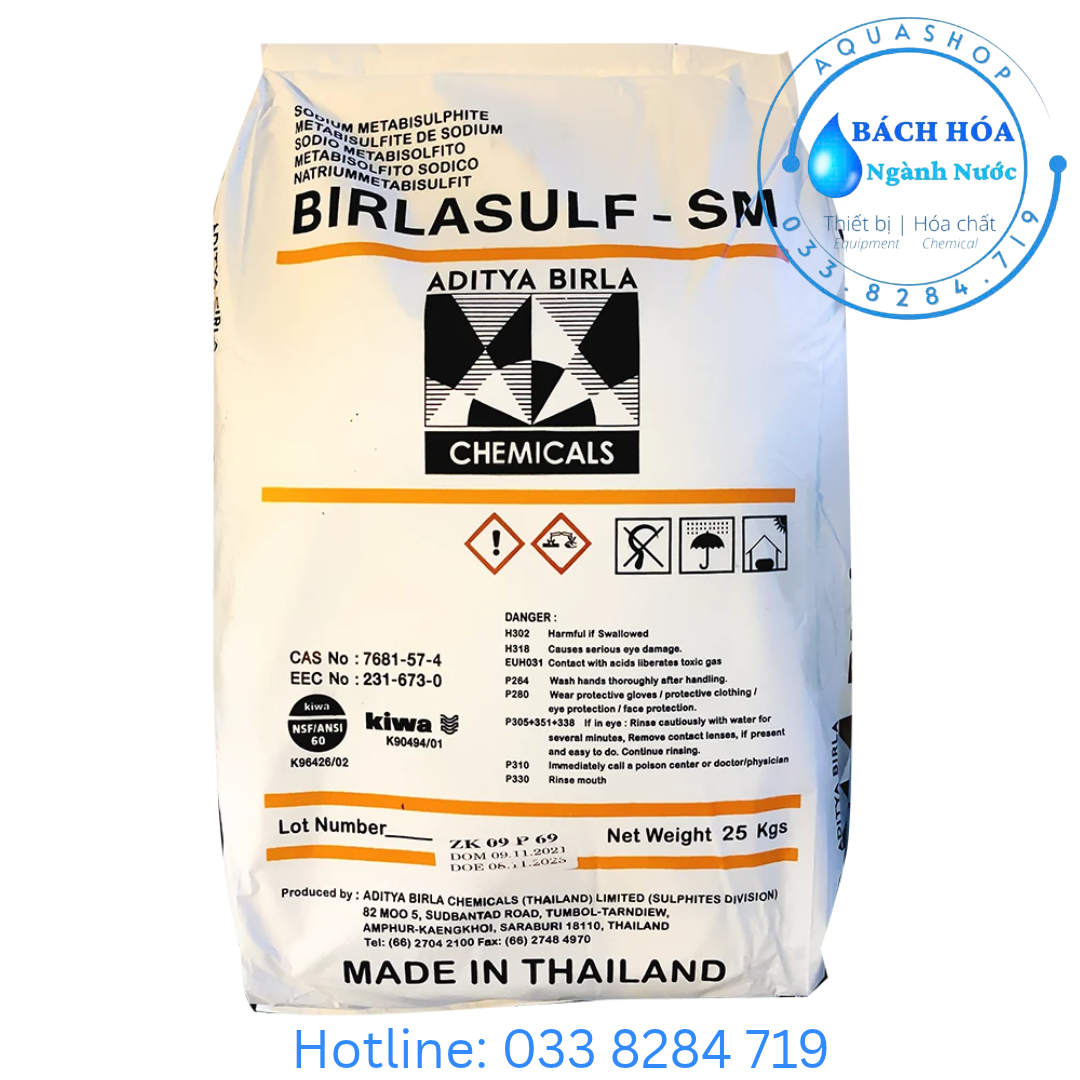
Sodium Metabisulfite SMBS 99% (Na₂S₂O₅) – Thái Lan là hóa chất công nghiệp dạng bột tinh thể màu trắng, có khả năng hòa tan tốt trong nước và tính khử mạnh. Sản phẩm được ứng dụng rộng rãi trong xử lý nước cấp, xử lý nước thải, hệ thống lọc RO để khử Clo dư, loại bỏ các chất oxy hóa, đồng thời sử dụng trong ngành dệt nhuộm, sản xuất giấy và công nghiệp hóa chất. Quy cách đóng gói 25kg/bao, phù hợp cho nhà máy, đơn vị xử lý môi trường và các công trình công nghiệp. AquaShop chuyên kết nối cung ứng hóa chất xử lý nước và hóa chất công nghiệp.
Sodium Metabisulfite SMBS 99% (Na₂S₂O₅) – Thailand is a high-purity industrial chemical supplied in white crystalline powder form, with excellent water solubility and strong reducing properties. It is widely used in water treatment, wastewater treatment, and reverse osmosis (RO) systems for residual chlorine removal and neutralization of oxidizing agents. It is also applied in textile dyeing, pulp and paper manufacturing, and chemical processing. Supplied in 25kg bags, Sodium Metabisulfite is an ideal solution for industrial factories, water treatment contractors, and environmental treatment facilities. AquaShop – Connecting Industrial Water Treatment Solutions.
Sodium Metabisulfite (SMB/ SBS) hay còn gọi là Natri Metabisunfit, Natri Metabisulfit, Natri Pyrosulfite là một hợp chất vô cơ có công thức hóa học Na₂S₂O₅. Đây là hóa chất có tính khử mạnh, được ứng dụng rộng rãi trong nhiều lĩnh vực công nghiệp như xử lý nước cấp, xử lý nước thải, dệt nhuộm, sản xuất giấy, chế biến thực phẩm và các ngành công nghiệp hóa chất.
Sodium Metabisulfite SBS 99% xuất xứ Thái Lan có dạng bột tinh thể màu trắng hoặc trắng ngả vàng, dễ hòa tan trong nước. Khi hòa tan, sản phẩm tạo thành dung dịch chứa các ion bisulfite có khả năng tham gia vào các phản ứng khử và loại bỏ một số chất oxy hóa trong môi trường nước.
Trong lĩnh vực xử lý nước công nghiệp, Sodium Metabisulfite thường được sử dụng để khử Clo dư, xử lý Chloramine và loại bỏ các chất oxy hóa trước khi nước được đưa vào những công đoạn xử lý tiếp theo.
Với hàm lượng 99% và quy cách đóng gói 25kg/bao, sản phẩm phù hợp với nhu cầu sử dụng tại các nhà máy sản xuất, hệ thống xử lý nước và đơn vị thi công công trình môi trường.
| Thông tin | Chi tiết |
|---|---|
| Tên sản phẩm | Sodium Metabisulfite (SBS) |
| Tên gọi khác | Natri Metabisunfit, Sodium Pyrosulfite |
| Công thức hóa học | Na₂S₂O₅ |
| CAS Number | 7681-57-4 |
| Hàm lượng | 99% |
| Xuất xứ | Thái Lan |
| Ngoại quan | Bột tinh thể màu trắng hoặc vàng nhạt |
| Khả năng hòa tan | Tan trong nước |
| Quy cách đóng gói | 25kg/bao |
| Ứng dụng | Xử lý nước, xử lý nước thải, dệt nhuộm, giấy và công nghiệp |
Sodium Metabisulfite có những đặc điểm vật lý cơ bản sau:
Sodium Metabisulfite là chất có tính khử, có khả năng phản ứng với nhiều chất oxy hóa.
Khi hòa tan trong nước, Sodium Metabisulfite hình thành các ion bisulfite:
Na₂S₂O₅ + H₂O ⇌ 2Na⁺ + 2HSO₃⁻
Các ion bisulfite đóng vai trò quan trọng trong các phản ứng khử, đặc biệt là phản ứng loại bỏ Clo dư trong nước.
Phản ứng khử Clo:
Na₂S₂O₅ + 2Cl₂ + 3H₂O → 2NaHSO₄ + 4HCl
Phản ứng trên minh họa khả năng khử Clo của Sodium Metabisulfite trong môi trường nước.
Ngoài ra, khi tiếp xúc với axit mạnh, Sodium Metabisulfite có thể giải phóng khí Sulfur Dioxide (SO₂). Vì vậy, cần tránh để sản phẩm tiếp xúc trực tiếp với axit trong quá trình bảo quản và sử dụng.
Một trong những ứng dụng quan trọng của Sodium Metabisulfite là khử Clo dư trong nước.
Trong các hệ thống xử lý nước sử dụng Clo để khử trùng, lượng Clo dư cần được kiểm soát trước khi nước đi vào những công đoạn tiếp theo.
Sodium Metabisulfite được sử dụng để:
Trong hệ thống lọc nước RO (Reverse Osmosis), Clo tự do có thể gây ảnh hưởng đến tuổi thọ và hiệu suất của màng lọc RO polyamide.
Sodium Metabisulfite được sử dụng tại công đoạn tiền xử lý nhằm khử Clo dư trước khi nước đi vào màng RO.
Lợi ích khi sử dụng SBS trong hệ thống RO:
Việc sử dụng hóa chất cần được tính toán theo lưu lượng nước, nồng độ Clo đầu vào và yêu cầu chất lượng nước sau xử lý.
Sodium Metabisulfite được sử dụng trong một số quy trình xử lý nước thải công nghiệp với vai trò là chất khử.
Sản phẩm có thể được ứng dụng để:
Đối với các nhà máy sản xuất có sử dụng Clo hoặc hóa chất oxy hóa trong quy trình sản xuất, việc bổ sung Sodium Metabisulfite có thể giúp kiểm soát lượng chất oxy hóa tồn dư trước khi xả thải.
Trong ngành dệt nhuộm, Sodium Metabisulfite được sử dụng trong một số công đoạn khử màu, xử lý thuốc nhuộm và xử lý hóa chất trong quy trình sản xuất.
Các ứng dụng phổ biến:
Sodium Metabisulfite được sử dụng trong một số quy trình sản xuất giấy và bột giấy với vai trò là chất khử, hỗ trợ quá trình xử lý nguyên liệu và kiểm soát các phản ứng oxy hóa.
Sản phẩm có thể tham gia vào các công đoạn xử lý hóa chất, tẩy trắng và cải thiện đặc tính nguyên liệu tùy theo công nghệ sản xuất.
Sodium Metabisulfite còn được biết đến với mã phụ gia thực phẩm E223.
Trong ngành thực phẩm, sản phẩm được sử dụng làm chất chống oxy hóa và chất bảo quản trong một số ứng dụng được phép, giúp hạn chế hiện tượng biến đổi màu và quá trình oxy hóa.
Lưu ý: Chỉ sử dụng sản phẩm đạt tiêu chuẩn Food Grade, có hồ sơ chứng nhận phù hợp và tuân thủ giới hạn sử dụng theo quy định hiện hành. Không sử dụng hóa chất công nghiệp thay thế cho phụ gia thực phẩm.
Ngoài những lĩnh vực trên, Sodium Metabisulfite còn được sử dụng trong:
Để đạt hiệu quả xử lý tốt, Sodium Metabisulfite cần được sử dụng theo đặc tính nguồn nước và yêu cầu công nghệ.
Quy trình sử dụng tham khảo:
Bước 1: Kiểm tra chất lượng nước đầu vào
Xác định lưu lượng nước, nồng độ Clo dư, Chloramine hoặc các chất oxy hóa cần xử lý.
Bước 2: Chuẩn bị dung dịch hóa chất
Hòa tan Sodium Metabisulfite vào nước sạch trong bồn pha hóa chất. Khuấy đều để tạo dung dịch đồng nhất.
Bước 3: Châm hóa chất vào hệ thống
Sử dụng bơm định lượng để châm dung dịch Sodium Metabisulfite vào đường ống hoặc bể xử lý theo thiết kế công nghệ.
Bước 4: Kiểm tra hiệu quả xử lý
Đo kiểm nồng độ Clo dư hoặc chỉ tiêu chất oxy hóa sau điểm châm để đánh giá hiệu quả khử.
Bước 5: Điều chỉnh liều lượng
Điều chỉnh lượng hóa chất theo kết quả kiểm tra thực tế nhằm đảm bảo hiệu quả xử lý và tránh sử dụng dư thừa.
Liều lượng sử dụng phải được tính toán dựa trên nồng độ chất oxy hóa, lưu lượng nước, thời gian tiếp xúc và điều kiện vận hành. Không nên áp dụng một mức châm cố định cho mọi hệ thống.
Sodium Metabisulfite là hóa chất được sử dụng phổ biến trong các hệ thống xử lý nước nhờ những đặc điểm sau:
Sodium Metabisulfite là hóa chất công nghiệp cần được bảo quản và sử dụng đúng hướng dẫn an toàn.
Khi sử dụng:
Khi bảo quản:
Tham khảo Phiếu an toàn hóa chất (SDS/MSDS) của sản phẩm trước khi sử dụng.
AquaShop – Bách Hóa Ngành Nước là kênh kết nối và tư vấn giải pháp cung ứng hóa chất, thiết bị phục vụ ngành xử lý nước cấp, xử lý nước thải và sản xuất công nghiệp.
Chúng tôi hướng đến việc kết nối khách hàng với các nguồn cung ứng phù hợp, hỗ trợ lựa chọn sản phẩm theo yêu cầu kỹ thuật và nhu cầu thực tế của từng hệ thống.
Các nhóm sản phẩm AquaShop kết nối cung ứng:
Quý khách hàng có nhu cầu tìm hiểu hoặc mua Sodium Metabisulfite SBS 99% Thái Lan, vui lòng liên hệ AquaShop để được hỗ trợ thông tin sản phẩm, quy cách, báo giá và phương án cung ứng.
AquaShop – Bách Hóa Ngành Nước
AquaShop – You need, We’ll have it.
Đồng hành – Tận tâm – Hiệu quả.
—
Sodium Metabisulfite (SMBS), also known as Sodium Pyrosulfite or Disodium Metabisulfite, is an inorganic chemical compound with the molecular formula Na₂S₂O₅. It is widely used in industrial applications, particularly in water treatment, wastewater treatment, reverse osmosis (RO) systems, textile dyeing, pulp and paper manufacturing, and chemical processing.
Sodium Metabisulfite SBS 99% – Thailand is supplied in white to slightly yellowish crystalline powder form. It is readily soluble in water and has strong reducing properties, making it an effective chemical for removing residual chlorine and reducing various oxidizing agents in water.
In industrial water treatment systems, Sodium Metabisulfite plays an important role in dechlorination processes, especially in RO pretreatment systems where residual chlorine must be removed to protect sensitive reverse osmosis membranes.
With a purity of 99% and convenient 25kg packaging, this product is suitable for industrial factories, water treatment contractors, and environmental treatment facilities.
| Parameter | Description |
|---|---|
| Product Name | Sodium Metabisulfite |
| Abbreviation | SBS |
| Chemical Name | Sodium Metabisulfite |
| Chemical Formula | Na₂S₂O₅ |
| CAS Number | 7681-57-4 |
| Purity | 99% |
| Appearance | White to slightly yellowish crystalline powder |
| Solubility | Soluble in water |
| Molecular Weight | 190.11 g/mol |
| Origin | Thailand |
| Packaging | 25kg/bag |
| Main Applications | Water treatment, wastewater treatment, RO systems, textile and paper industries |
Sodium Metabisulfite has the following characteristics:
Sodium Metabisulfite is a reducing agent that reacts with various oxidizing substances.
When dissolved in water, it forms bisulfite ions:
Na₂S₂O₅ + H₂O ⇌ 2Na⁺ + 2HSO₃⁻
These bisulfite ions are responsible for its reducing properties and ability to remove residual chlorine.
Chlorine removal reaction:
Na₂S₂O₅ + 2Cl₂ + 3H₂O → 2NaHSO₄ + 4HCl
This reaction illustrates the ability of Sodium Metabisulfite to neutralize free chlorine in water treatment applications.
When Sodium Metabisulfite comes into contact with strong acids, it may release sulfur dioxide (SO₂), a toxic gas. Therefore, it must be stored and handled away from incompatible acidic chemicals.
One of the most important applications of Sodium Metabisulfite is the removal of residual chlorine in water treatment systems.
Chlorine is commonly used for water disinfection. However, excessive residual chlorine can negatively affect downstream treatment processes and sensitive equipment.
Sodium Metabisulfite is used to:
Sodium Metabisulfite is widely used in reverse osmosis pretreatment systems.
Polyamide RO membranes are sensitive to free chlorine. Prolonged exposure to chlorine can cause membrane oxidation, reducing filtration performance and shortening membrane service life.
Sodium Metabisulfite is injected into the feedwater to remove residual chlorine before the water enters the RO membrane system.
Key benefits include:
The required dosage should be determined based on feedwater chlorine concentration, water flow rate, and operating conditions.
Sodium Metabisulfite is used as a reducing agent in various industrial wastewater treatment processes.
Typical applications include:
It is particularly useful in industrial facilities where chlorine or other oxidizing chemicals are used during production or wastewater treatment.
In textile manufacturing, Sodium Metabisulfite is used in certain reduction, dyeing, and fabric treatment processes.
Its applications include:
Sodium Metabisulfite is used in selected pulp and paper manufacturing processes as a reducing agent.
It may support:
Sodium Metabisulfite is also known as food additive E223.
In approved food-grade applications, it is used as an antioxidant and preservative to help prevent oxidation and unwanted color changes.
Important: Only certified food-grade Sodium Metabisulfite should be used in food processing. Industrial-grade products must not be substituted for food-grade materials. All applications must comply with applicable food safety regulations.
Sodium Metabisulfite is also used in:
For effective treatment, Sodium Metabisulfite dosage should be calculated according to water quality and system operating conditions.
Step 1: Analyze the incoming water
Determine the water flow rate, residual chlorine concentration, and other oxidizing substances that require treatment.
Step 2: Prepare the chemical solution
Dissolve Sodium Metabisulfite in clean water inside a suitable chemical preparation tank. Mix thoroughly until a uniform solution is obtained.
Step 3: Chemical dosing
Use a chemical dosing pump to inject the prepared solution into the water pipeline or treatment tank.
Step 4: Monitor treatment performance
Measure residual chlorine or other relevant parameters after the chemical injection point to evaluate treatment efficiency.
Step 5: Adjust the dosage
Adjust the chemical dosing rate according to actual test results and operating requirements.
The appropriate dosage depends on chlorine concentration, water flow rate, contact time, and system conditions. Jar testing or operational testing is recommended before establishing the final dosing rate.
Sodium Metabisulfite offers several advantages for industrial applications:
Sodium Metabisulfite should be handled according to chemical safety requirements.
AquaShop – Water Treatment Solutions & Industrial Chemicals is a business connection platform specializing in industrial water treatment chemicals, water treatment equipment, and environmental treatment solutions.
We connect customers with suitable suppliers and provide product information and technical support based on actual industrial requirements.
Our product portfolio includes:
If you are looking for Sodium Metabisulfite SMBS 99% from Thailand, please contact AquaShop for product details, availability, quotations, and supply support.
AquaShop – Water Treatment Solutions & Industrial Chemicals
AquaShop – You need, We’ll have it.
Connecting Value – Dedicated Support – Effective Solutions.


Đánh giá
Chưa có đánh giá nào.