
BÁCH HÓA NGÀNH NƯỚC - AQUASHOP
"You need, We'll have it!" - Bạn cần, chúng tôi có!
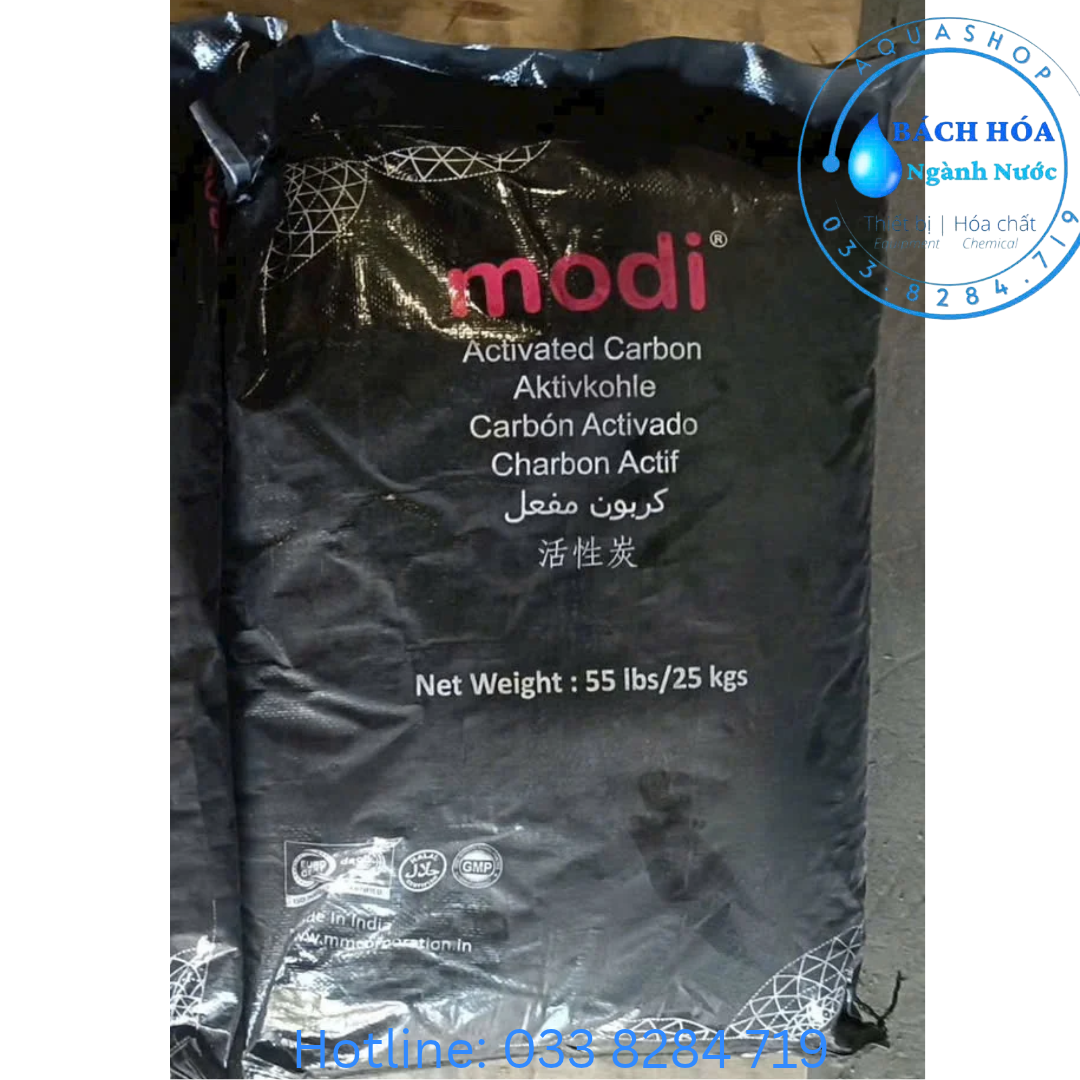
Than hoạt tính Ấn Độ MODI là vật liệu lọc dạng hạt có chỉ số Iodine 900–950 mg/g, diện tích bề mặt 900–930 m²/g, kích thước 8–16 mesh; dạng bột. Sản phẩm có khả năng hấp phụ các hợp chất hữu cơ, khử clo dư, giảm màu và mùi trong nước. Than hoạt tính MODI được ứng dụng rộng rãi trong hệ thống lọc nước sinh hoạt, xử lý nước cấp, tiền xử lý RO, xử lý nước thải công nghiệp và lọc khí khử mùi. Quy cách đóng gói 25 kg/bao, phù hợp cho nhiều công trình xử lý nước và môi trường.
MODI Indian Activated Carbon is a high-quality granular activated carbon originating from India, featuring an Iodine Number of 900–950 mg/g, a specific surface area of 900–930 m²/g, and a particle size of 8–16 mesh. It offers effective adsorption of organic compounds, residual chlorine, color-causing substances, and unpleasant odors. MODI activated carbon is widely used in domestic water filtration, industrial water treatment, RO pretreatment, wastewater treatment, and industrial air purification systems. Packaging: 25 kg/bag.
Than hoạt tính Ấn Độ MODI là dòng vật liệu lọc dạng hạt được sử dụng phổ biến trong các hệ thống xử lý nước cấp, lọc nước công nghiệp, xử lý nước sinh hoạt và một số ứng dụng xử lý khí. Sản phẩm có khả năng hấp phụ các hợp chất hữu cơ, clo dư, chất gây màu, mùi và nhiều tạp chất hòa tan trong nước.
Với chỉ số Iodine từ 900–950 mg/g, diện tích bề mặt riêng lớn và cấu trúc mao quản phát triển, than hoạt tính MODI là lựa chọn đáng cân nhắc cho các hệ thống lọc nước yêu cầu hiệu quả hấp phụ tốt và vận hành ổn định.
AquaShop – Bách Hóa Ngành Nước cung cấp và kết nối nguồn vật liệu lọc, hóa chất xử lý nước và thiết bị ngành nước, hỗ trợ khách hàng lựa chọn sản phẩm phù hợp với nhu cầu thực tế của từng công trình.
Than hoạt tính MODI có xuất xứ từ Ấn Độ, thuộc dòng than hoạt tính dạng hạt được sản xuất và cung cấp bởi MM Corporation.
Sản phẩm được ứng dụng trong nhiều lĩnh vực nhờ cấu trúc xốp với hệ thống mao quản phát triển. Đặc điểm này giúp tăng diện tích tiếp xúc giữa bề mặt than và các chất ô nhiễm, từ đó hỗ trợ quá trình hấp phụ trong hệ thống xử lý nước và lọc khí.
Trong công nghệ xử lý nước, than hoạt tính thường được bố trí tại công đoạn lọc hấp phụ nhằm:
Than hoạt tính MODI phù hợp với nhiều hệ thống lọc từ quy mô dân dụng đến các hệ thống xử lý nước công nghiệp.
| Thông số | Giá trị |
|---|---|
| Tên sản phẩm | Than hoạt tính MODI |
| Xuất xứ | Ấn Độ |
| Dạng sản phẩm | Than hoạt tính dạng hạt |
| Chỉ số Iodine | 900–950 mg/g; 600 mg/g |
| Kích thước hạt | 8–16 mesh; dạng bột |
| Diện tích bề mặt | 900–930 m²/g |
| Độ cứng cơ học | 98% |
| Tỷ trọng | Khoảng 550 kg/m³ |
| Độ ẩm | Nhỏ hơn 3,1% |
| Hàm lượng tro | Tối đa 4% |
| Quy cách đóng gói | 25 kg/bao |
| Tuổi thọ tham khảo | Khoảng 3–5 năm trong ứng dụng lọc nước |
Lưu ý: Thông số kỹ thuật được tổng hợp theo tài liệu tham khảo của sản phẩm. Khách hàng nên kiểm tra CO, CQ và tài liệu kỹ thuật của lô hàng thực tế trước khi sử dụng.
Chỉ số Iodine 900–950 mg/g cho thấy khả năng hấp phụ vi mao quản của sản phẩm ở mức tốt. Đây là một trong những chỉ tiêu thường được sử dụng để đánh giá khả năng hấp phụ của than hoạt tính.
Nhờ cấu trúc xốp và diện tích bề mặt lớn, than MODI hỗ trợ hấp phụ các hợp chất hữu cơ và một số chất gây mùi, màu trong nước.
Kích thước hạt 8–16 mesh giúp sản phẩm có thể được sử dụng trong các cột lọc áp lực, bồn lọc và hệ thống lọc nhiều tầng vật liệu.
Việc lựa chọn kích thước hạt phù hợp giúp cân đối giữa hiệu quả tiếp xúc, tổn thất áp lực và khả năng rửa ngược của hệ thống.
Độ cứng cơ học được công bố ở mức 98%, hỗ trợ hạn chế hiện tượng vỡ vụn và hao hụt vật liệu trong quá trình vận hành.
Đây là đặc tính quan trọng đối với các hệ thống lọc hoạt động liên tục, có chu kỳ rửa ngược định kỳ.
Diện tích bề mặt khoảng 900–930 m²/g tạo điều kiện thuận lợi cho quá trình tiếp xúc và hấp phụ các chất ô nhiễm.
Đặc tính này giúp than hoạt tính MODI trở thành vật liệu được quan tâm trong các ứng dụng xử lý nước cấp, nước sinh hoạt và lọc nước công nghiệp.
Than hoạt tính MODI có dạng hạt, thuận tiện cho việc đổ vật liệu vào cột lọc, bồn lọc hoặc thiết bị lọc chuyên dụng. Khi vật liệu suy giảm khả năng hấp phụ, đơn vị vận hành có thể kiểm tra và thay thế theo tình trạng thực tế của hệ thống.
Than hoạt tính MODI được sử dụng trong các hệ thống lọc nước giếng khoan, nước máy và hệ thống xử lý nước sinh hoạt.
Một số công dụng:
Than hoạt tính thường được kết hợp với cát thạch anh, sỏi đỡ, mangan và các vật liệu lọc khác tùy theo đặc điểm nguồn nước đầu vào.
Trong hệ thống RO, than hoạt tính thường được bố trí ở công đoạn tiền xử lý để giảm clo dư và một số hợp chất hữu cơ trước khi nước đi vào màng RO.
Điều này đặc biệt quan trọng đối với màng RO polyamide có khả năng bị oxy hóa bởi clo tự do.
Sử dụng than hoạt tính phù hợp giúp:
Cần kiểm tra clo dư sau cột than bằng phương pháp đo phù hợp để đảm bảo nước đạt yêu cầu trước khi cấp vào màng RO.
Trong một số hệ thống xử lý nước thải, than hoạt tính được sử dụng tại công đoạn xử lý bậc ba hoặc công đoạn xử lý hoàn thiện.
Các ứng dụng bao gồm:
Đối với nước thải dệt nhuộm, thực phẩm, giấy và các ngành sản xuất khác, cần đánh giá đặc tính nước thải và thử nghiệm hấp phụ trước khi lựa chọn vật liệu.
Than hoạt tính có thể được sử dụng trong các thiết bị hấp phụ khí nhằm xử lý một số hợp chất hữu cơ dễ bay hơi (VOC) và các thành phần gây mùi.
Ứng dụng phổ biến:
Tùy theo thành phần khí, độ ẩm, nhiệt độ và nồng độ chất ô nhiễm, cần lựa chọn đúng chủng loại than hoạt tính và thiết kế thời gian tiếp xúc phù hợp.
Than hoạt tính có thể được sử dụng trong một số hệ thống lọc tuần hoàn nhằm hấp phụ chất hữu cơ hòa tan, hợp chất gây màu và mùi.
Tuy nhiên, than hoạt tính không thay thế được các công đoạn xử lý sinh học và các giải pháp kiểm soát NH₃, NO₂ chuyên dụng.
Than hoạt tính hoạt động chủ yếu dựa trên cơ chế hấp phụ.
Khi dòng nước hoặc dòng khí đi qua lớp vật liệu, các phân tử chất ô nhiễm có thể tiếp xúc và bị giữ lại trên bề mặt cũng như bên trong hệ thống mao quản của hạt than.
Quá trình này phụ thuộc vào nhiều yếu tố:
Do đó, việc lựa chọn than hoạt tính cần căn cứ vào mục tiêu xử lý và thông số vận hành của từng hệ thống thay vì chỉ dựa vào chỉ số Iodine.
Kiểm tra bao bì, tình trạng hạt than và các thông tin kỹ thuật của sản phẩm.
Trước khi đưa vào vận hành, cần sàng lọc nếu cần thiết để loại bỏ bụi than và tạp chất không mong muốn.
Đổ than hoạt tính vào cột lọc hoặc bồn lọc theo thiết kế kỹ thuật.
Nên bố trí lớp sỏi đỡ hoặc hệ thống phân phối nước phù hợp để tránh thất thoát vật liệu trong quá trình vận hành.
Tiến hành rửa ngược để loại bỏ bụi mịn và các hạt nhỏ còn sót lại.
Sau đó rửa xuôi cho đến khi nước đầu ra tương đối trong trước khi đưa hệ thống vào hoạt động chính thức.
Lưu lượng rửa cần được tính toán theo kích thước hạt, tỷ trọng, chiều cao lớp than và cấu tạo thiết bị.
Kiểm tra định kỳ các chỉ tiêu chất lượng nước theo mục tiêu thiết kế, chẳng hạn như clo dư, độ màu, mùi, COD hoặc các hợp chất hữu cơ liên quan.
Khi hiệu quả hấp phụ suy giảm, cần đánh giá khả năng thay thế hoặc tái sinh vật liệu theo hướng dẫn kỹ thuật.
Để hệ thống lọc hoạt động ổn định, doanh nghiệp cần lưu ý:
Đặc biệt, đối với hệ thống RO, cần kiểm tra clo dư sau cột than để đảm bảo khả năng bảo vệ màng lọc.
Than hoạt tính MODI có thể là lựa chọn phù hợp khi doanh nghiệp cần:
Nếu hệ thống yêu cầu xử lý chuyên sâu các chất hữu cơ đặc thù, VOC hoặc khí thải có thành phần phức tạp, nên thực hiện thử nghiệm và lựa chọn chủng loại than theo yêu cầu thực tế.
AquaShop – Bách Hóa Ngành Nước là kênh kết nối khách hàng với các nguồn cung cấp hóa chất, vật liệu lọc và thiết bị phục vụ ngành xử lý nước.
Chúng tôi hướng đến việc hỗ trợ nhà thầu môi trường, đơn vị thi công hệ thống xử lý nước, nhà máy sản xuất và doanh nghiệp thương mại tìm kiếm nguồn hàng phù hợp với yêu cầu kỹ thuật và ngân sách.
Ngoài than hoạt tính MODI Ấn Độ, AquaShop còn kết nối các dòng sản phẩm:
AquaShop – You need, We’ll have it.
Chúng tôi không chỉ cung cấp sản phẩm mà còn hướng đến kết nối nguồn hàng, giải pháp và đối tác nhằm hỗ trợ khách hàng triển khai công việc hiệu quả.
Quý khách đang cần tìm nguồn than hoạt tính Ấn Độ MODI phục vụ hệ thống lọc nước, xử lý nước công nghiệp hoặc các công trình môi trường?
Hãy liên hệ AquaShop để được hỗ trợ thông tin sản phẩm, tư vấn lựa chọn vật liệu và kết nối nguồn cung theo nhu cầu thực tế.
AQUASHOP – BÁCH HÓA NGÀNH NƯỚC
AquaShop – Đồng hành, tận tâm, hiệu quả.
—
MODI Indian Activated Carbon is a granular activated carbon product originating from India, widely used in water filtration, industrial water treatment, wastewater treatment, and air purification systems.
With an Iodine Number of 900–950 mg/g, a specific surface area of approximately 900–930 m²/g, and a developed porous structure, MODI activated carbon provides effective adsorption performance for removing various organic compounds, residual chlorine, color-causing substances, and unpleasant odors.
AquaShop – Water Industry Supermarket supplies and connects customers with activated carbon, filtration media, water treatment chemicals, and industrial water treatment equipment for various applications.
MODI Activated Carbon is a granular adsorption material originating from India and supplied by MM Corporation.
The product features a porous structure with a large internal surface area, allowing contaminants to come into contact with the carbon surface and be retained through the adsorption process.
In water treatment applications, activated carbon is commonly used to:
MODI activated carbon is suitable for various filtration applications, from domestic water purification to industrial water treatment systems.
| Parameter | Specification |
|---|---|
| Product name | MODI Activated Carbon |
| Origin | India |
| Supplier | MM Corporation |
| Product form | Granular activated carbon |
| Iodine Number | 900–950 mg/g |
| Particle size | 8–16 mesh |
| Specific surface area | 900–930 m²/g |
| Hardness | 98% |
| Bulk density | Approximately 550 kg/m³ |
| Moisture content | Less than 3.1% |
| Ash content | Maximum 4% |
| Packaging | 25 kg/bag |
| Reference service life | Approximately 3–5 years, depending on operating conditions |
Note: The specifications above are compiled from available product reference information. Please check the actual manufacturer’s technical datasheet and quality certificates before purchasing.
With an Iodine Number of 900–950 mg/g, MODI activated carbon offers good micropore adsorption characteristics.
Its porous structure provides a large contact surface, supporting the adsorption of organic compounds and certain substances responsible for unpleasant odors and colors in water.
The 8–16 mesh particle size makes this product suitable for use in:
Proper particle size selection helps balance adsorption performance, pressure drop, and backwashing requirements.
With a specified hardness of 98%, MODI activated carbon offers good resistance to mechanical breakdown during operation.
This characteristic helps reduce particle degradation and material loss during filtration and periodic backwashing.
The specific surface area of approximately 900–930 m²/g provides favorable conditions for contact between the carbon surface and contaminants.
This makes MODI activated carbon a suitable option for various industrial and domestic water filtration applications.
The granular form allows easy loading into filtration vessels, pressure filters, and specialized adsorption equipment.
When adsorption performance decreases, the carbon can be inspected and replaced according to actual system operating conditions.
MODI activated carbon can be used in water purification systems for groundwater, municipal water, and domestic water supplies.
Its applications include:
Activated carbon is commonly combined with quartz sand, gravel, manganese media, and other filtration materials depending on the characteristics of the incoming water.
Activated carbon is widely used in the pretreatment stage of reverse osmosis systems.
Its main function is to reduce free chlorine and certain organic compounds before water enters the RO membrane.
This is particularly important for polyamide RO membranes, which can be damaged by oxidation from free chlorine.
Using suitable activated carbon helps:
Residual chlorine should be monitored after the activated carbon filter to ensure that the water meets the membrane manufacturer’s requirements.
In industrial wastewater treatment systems, activated carbon is often used in tertiary treatment or final polishing stages.
Typical applications include:
For wastewater from textile dyeing, food processing, paper manufacturing, and other industries, adsorption testing is recommended before selecting the appropriate activated carbon.
Activated carbon can also be used in adsorption equipment for treating air streams containing certain volatile organic compounds (VOCs) and odor-causing substances.
Common applications include:
The appropriate carbon type and system design should be selected based on gas composition, humidity, temperature, contaminant concentration, and required contact time.
Activated carbon can be used in certain recirculating aquaculture systems to adsorb dissolved organic compounds and substances that cause color and odor.
However, activated carbon does not replace biological filtration or specialized ammonia and nitrite control processes.
Activated carbon primarily works through the adsorption mechanism.
When water or air passes through the carbon bed, contaminant molecules come into contact with the carbon surface and may be retained within its porous structure.
The adsorption efficiency depends on several factors:
Therefore, activated carbon selection should be based on actual treatment objectives and system operating conditions rather than the Iodine Number alone.
Check the packaging, particle condition, and technical specifications before use.
If necessary, screen the material to remove excessive fines and unwanted impurities.
Load the activated carbon into the filtration vessel according to the system design.
A suitable gravel support layer and water distribution system should be installed to prevent carbon loss during operation.
Perform backwashing to remove fine particles and residual carbon dust.
Then rinse the filter until the outlet water becomes relatively clear before putting the system into normal operation.
Backwash flow rates should be calculated according to particle size, bulk density, carbon bed depth, and filter configuration.
Regularly monitor water quality parameters based on the treatment objectives, such as:
When adsorption performance decreases, evaluate the need for carbon replacement or regeneration according to technical recommendations.
To ensure stable filtration performance, businesses should consider:
For RO pretreatment applications, residual chlorine monitoring after the carbon filter is particularly important to protect the membranes.
MODI activated carbon can be considered for applications requiring:
For specialized organic pollutants, VOCs, or complex industrial exhaust streams, additional testing and technical evaluation are recommended to determine the most suitable carbon grade.
AquaShop – Water Industry Supermarket is a connection platform for customers seeking water treatment chemicals, filtration materials, and industrial water treatment equipment.
We support environmental contractors, water treatment system integrators, manufacturing plants, and industrial businesses in finding suitable products and supply sources based on technical requirements and project budgets.
In addition to MODI Indian Activated Carbon, AquaShop connects customers with a wide range of products:
AquaShop – You need, We’ll have it.
We focus not only on product supply but also on connecting customers with reliable sources, technical solutions, and business partners to support efficient project implementation.
Are you looking for MODI Indian Activated Carbon for water filtration, industrial water treatment, RO pretreatment, or environmental projects?
Contact AquaShop for product information, technical consultation, and supply connections based on your actual requirements.
AQUASHOP – WATER INDUSTRY SUPERMARKET
AquaShop – Partnership, Dedication, Efficiency.




Đánh giá
Chưa có đánh giá nào.